Why Hat Care Is a Procurement Issue, Not Just an End-User Issue
How to clean, store, reshape, and extend the lifespan of wholesale straw hats. Material-specific care guide for procurement managers and brand buyers.
Byadmin
Table of Contents
Why Hat Care Is a Procurement Issue, Not Just an End-User Issue
When institutional buyers specify a straw hat rated for 2–3 seasons, that lifespan assumes proper handling and storage. In practice, the difference between a hat that lasts two full seasons and one that cracks, warps, or fades after six months almost always comes down to care — not manufacturing quality.
For procurement managers sourcing straw hats for lifeguard departments, resort staff, corporate gifting programs, or retail private-label lines, care guidance is part of the product specification. Hats that fail prematurely generate replacement orders, warranty disputes, and brand complaints. Hats that arrive with clear care instructions — and are used accordingly — deliver the full value of the original purchase.
This guide covers the care requirements for the five natural fiber types used across StrawHatWholesale’s product range: Mat Grass, Cattail Grass, Hollow Straw, Sennit Straw, and Panama Straw. It is written for buyers who need to brief end-users, write care card copy, or evaluate whether a hat’s construction is suited to its intended deployment environment.
Understanding the Materials: What You’re Caring For
Care requirements differ by fiber type. Before reviewing handling and cleaning procedures, it helps to understand what each material is and how it behaves under stress.
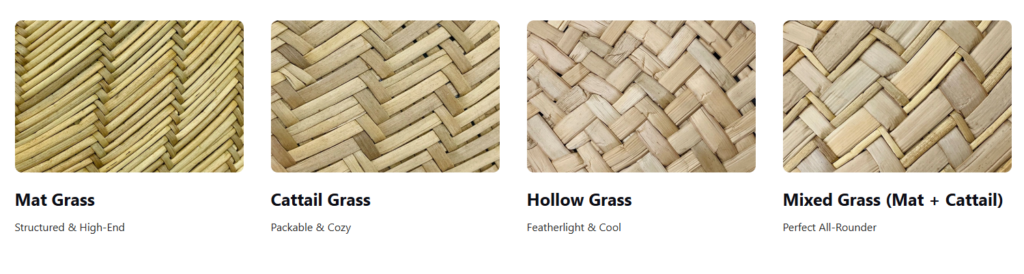
Mat Grass is a dense, flat-blade natural fiber with high cellulose content and low moisture absorption. It produces a tight, structured weave with excellent shape retention. It is the most durable of the five materials and the most forgiving of outdoor conditions. Used in lifeguard hats, wide-brim beach hats, cowboy hats, and bucket hats. Rated 2–3 seasons with standard care.
Cattail Grass (Typha latifolia / Typha angustifolia) is a softer, broader-leaf fiber with a spongy internal structure. It is lighter than Mat Grass and has a more organic, irregular surface texture. It is more susceptible to moisture damage and requires dry storage. Used in floppy beach hats, packable hats, and premium resort styles. Rated 2–3 seasons in dry climates; 1–2 seasons in high-humidity environments. [Source: PMC/NIH Cattail Biomass Review — https://pmc.ncbi.nlm.nih.gov/articles/PMC11717672/]
Hollow Straw is a lightweight, tubular-stem fiber that provides structural rigidity with excellent airflow. The hollow core makes it lighter than Mat Grass while maintaining brim shape. Used in fedora-style hats and fashion straw hats. Moderately sensitive to sustained moisture.
Sennit Straw is a braided or plaited straw construction — typically paper braid, toyo, or processed natural straw — used in boater (skimmer) hats. It produces a stiff, flat-top, flat-brim profile. Sennit construction is more sensitive to moisture than woven grass bodies; sustained water exposure can cause the braid to separate or the crown to lose its flat profile. For compliance programs, brim integrity is not merely cosmetic: the Skin Cancer Foundation recommends a brim of at least 3 inches all around for effective face and neck shading [Source: Skin Cancer Foundation — https://www.skincancer.org/blog/search-perfect-hat/], and a deformed brim that drops below this threshold reduces the hat’s protective coverage.
Panama Straw refers to hats woven from toquilla palm (Carludovica palmata) fiber — a lightweight, fine-weave natural material. Panama hats are the most delicate of the five types and require the most careful handling. They are sensitive to both moisture and dryness, and reshaping requires steam applied with care.
Handling: The First Line of Defense
Improper handling is the most common cause of premature straw hat damage — and the easiest to prevent with a brief end-user briefing.
Always handle by the brim, not the crown. Gripping the crown concentrates pressure on the hat’s most structurally vulnerable point. For woven grass hats (Mat Grass, Cattail Grass, Hollow Straw), repeated crown-gripping can crack the weave at stress points. For Panama hats, it can permanently dent the crown.
Keep hands clean and dry when handling. Natural oils, sunscreen, and salt from hands accelerate fiber degradation and staining. This is particularly relevant for lifeguard and beach staff programs where hats are handled frequently throughout the day.
Do not rest the hat brim-down on a flat surface. This warps the brim over time. If the hat must be set down, place it crown-down (upside down) on a clean surface. For structured styles (boater, fedora), a hat stand is strongly preferred.
Do not compress or fold styles not designed for it. Packable and foldable styles — such as StrawHatWholesale’s Packable Beach Straw Hat — are engineered to compress and recover. Lifeguard hats, boater hats, and fedoras are not. Attempting to pack a structured hat will crack the weave or permanently deform the brim.
Storage: Protecting the Investment Between Uses
The primary storage risk for natural straw hats is drying out. Straw fiber that loses moisture becomes brittle and cracks under handling stress. The secondary risk is deformation from improper support.
Short-Term Storage (Daily / Weekly)
- Place the hat on a hat stand or hat block that matches the crown shape. This is the preferred method for all structured styles.
- If a stand is not available, hang the hat on a hook by the brim — not by the crown.
- Keep away from direct sunlight, heat sources, and high-humidity environments (e.g., do not store near kitchen steam or bathroom moisture).
- For Sennit Straw boater hats: always store on a flat-crown hat block or in a box. The flat-top profile is easily deformed by hanging.
Long-Term Storage (Seasonal / Off-Season)
- Store in a dedicated hat box with a tissue paper cradle. Place the hat crown-down into the cradle so the brim is supported without pressure points.
- A standard cardboard box with a lid works equally well — form a tissue paper nest inside and place the hat crown-down.
- Keep the box away from direct sunlight, heat, and humidity. A cool, dry interior shelf is ideal. Textile-conservation guidance from the Smithsonian Museum Conservation Institute recommends a stable relative humidity of 45% ± 8% (37–53%) for natural fiber storage [Source: Smithsonian MCI — https://mci.si.edu/climate-and-textiles-storage] — a benchmark worth meeting for off-season warehousing of bulk inventory.
- Do not store in plastic bags or sealed containers without ventilation. Trapped moisture accelerates mold growth on natural fiber; sealed plastic is the most common cause of mold damage in off-season hat storage.
- If a hat feels dry or looks slightly brittle after a storage period, light steam will rehydrate the fiber before use. See the Steaming section below.
Storage by Material
| Material | Primary Storage Risk | Recommended Method |
|---|---|---|
| Mat Grass | Drying / cracking | Hat stand or hat box with cradle |
| Cattail Grass | Moisture damage / mold | Dry environment; hat box with ventilation |
| Hollow Straw | Brim deformation | Hat stand; avoid hanging |
| Sennit Straw | Crown deformation | Flat-crown hat block or box |
| Panama Straw | Drying / cracking | Hat box with tissue cradle; avoid compression |
Cleaning: Routine Maintenance and Stain Removal
Routine Cleaning
- Brush the hat regularly with a soft-bristled hat brush or a clean microfiber cloth. Brush in the direction of the weave to avoid snagging fibers.
- For Hollow Straw and Panama hats — which have finer weave structures — use a soft cloth rather than a brush to avoid catching on the open weave.
- Remove dust and debris after each use, particularly for hats deployed in outdoor environments (beach, fishing, outdoor events).
Light Stain Removal
- Dampen a soft cloth with warm water and a small amount of mild detergent (pH-neutral, no bleach).
- Wring the cloth thoroughly before applying — the cloth should be barely damp, not wet. Soaking natural straw fiber weakens the weave and can cause permanent warping.
- Wipe the stained area gently. Do not scrub.
- Allow the hat to air-dry completely in a well-ventilated area before wearing or storing. Do not use a hair dryer or place near a heat source to accelerate drying.
What to Avoid
- Do not submerge or soak any natural straw hat. Full immersion will cause fiber swelling, weave distortion, and loss of shape.
- Do not machine wash. No natural straw hat style in StrawHatWholesale’s range is machine-washable.
- Do not use bleach or solvent-based cleaners. These will degrade the fiber and strip any applied finishes.
- Do not use a hair dryer or direct heat to dry a wet hat. Rapid drying causes fiber contraction and cracking.
Sweatband Cleaning
Most StrawHatWholesale hats include a cotton or polyester sweatband. The sweatband can be wiped with a damp cloth and mild detergent independently of the hat body. Allow to dry fully before wearing.
Steaming and Reshaping: Recovering Deformed Hats
Steam is the most effective tool for reshaping a deformed straw hat and rehydrating a dry one. It works by temporarily softening the fiber, allowing it to be repositioned before it sets in its new shape as it cools and dries.
Equipment: A dedicated garment steamer or a kitchen kettle with a directed steam spout. A hot shower in a closed bathroom also works for light rehydration (hang the hat on a towel hook while showering — do not expose directly to water).
Reshaping Procedure
- Apply steam to the deformed area for 30–60 seconds, keeping the steam source 2–4 inches from the hat surface.
- While the fiber is warm and pliable, gently work the hat back into shape by hand. For brim warps, press the brim flat against a clean surface. For crown dents, push from the inside.
- Hold the shape until the hat cools and begins to set — approximately 1–2 minutes.
- Allow the hat to dry completely on a hat stand or hat block before wearing or storing. Do not rush this step.
Material-Specific Notes
- Mat Grass and Cattail Grass: Respond well to steam. Apply for 1–2 minutes for significant deformation. Reshape immediately while warm.
- Hollow Straw: Responds to steam but requires a lighter touch — the hollow fiber structure is more sensitive to sustained heat. Apply steam in shorter intervals (20–30 seconds) and check shape between applications.
- Sennit Straw (Boater): Steam can be used to soften the braid for minor reshaping, but the flat-top, flat-brim profile of a boater hat is difficult to restore once significantly deformed. Prevention — proper storage on a flat-crown block — is more effective than correction.
- Panama Straw: The most steam-responsive of the five materials. Panama hats can be reshaped effectively with steam, but the fine weave requires careful handling while warm. Support the crown from the inside while reshaping the brim.
Hat Stiffener
For hats that have gone limp (particularly Cattail Grass styles in humid environments), a straw-safe hat stiffener spray can be applied after steaming and reshaping to help the hat hold its new shape. Follow the manufacturer’s instructions. Test on a small, inconspicuous area first.
Stretching: When and How
Stretching a straw hat to accommodate a larger head size is possible but carries risk. Do not attempt to stretch a straw hat more than two hat sizes (approximately 0.75 in / 2 cm in head circumference). Stretching beyond this range risks cracking the weave or permanently warping the brim.
For institutional buyers issuing hats as staff uniforms, the practical recommendation is to order in the correct size range from the outset rather than relying on post-production stretching. StrawHatWholesale’s head circumference sizing guide covers adult sizes from 18.9 in to 23.6 in across seven size options, and kids’ sizes from approximately 17.3 in to 21.3 in.
If stretching is necessary:
- Steam the hat for 1–2 minutes to soften the fiber.
- Insert a dedicated hat stretcher (hat jack) and expand gradually to the target size.
- Allow the hat to dry completely on the stretcher before removing.
- Do not force the stretcher beyond the hat’s natural resistance.
Care by Hat Style: Quick Reference
| Hat Style | Material | Packable? | Steam OK? | Soak? | Storage Method |
|---|---|---|---|---|---|
| Lifeguard / Wide Brim | Mat Grass / Cattail | No | Yes | No | Hat stand or box with cradle |
| Fedora | Hollow Straw | No | Yes (light) | No | Hat stand; avoid hanging |
| Boater / Skimmer | Sennit Straw | No | Yes (minor) | No | Flat-crown block or box |
| Floppy Beach Hat | Cattail / Mat Grass | Limited | Yes | No | Hat box; dry environment |
| Packable Beach Hat | Mixed Grass | Yes | Yes | No | Rolled or folded per design |
| Bucket Hat | Mat Grass | No | Yes | No | Hat stand or box with cradle |
| Panama Hat | Panama Straw | No | Yes (careful) | No | Hat box with tissue cradle |
Briefing End-Users: What to Include on a Care Card
For buyers issuing hats as staff uniforms, branded merchandise, or retail products, a care card or hang tag with basic instructions reduces premature failure and end-user complaints. The following points cover the minimum required:
- Handle by the brim, not the crown.
- Do not soak, submerge, or machine wash.
- Store away from direct sunlight and heat.
- Use a hat stand or hat box for storage — do not stack.
- If the hat loses shape, light steam and gentle hand-reshaping will restore it.
- Allow to dry completely before wearing after any moisture exposure.
For programs with specific compliance requirements — such as SLSA-affiliated lifeguard associations requiring documented UPF 50+ performance — note that the UPF 50+ rating is carried by the certified under-brim liner, tested to AS/NZS 4399:2020. [Source: Standards Australia — https://store.standards.org.au/product/as-nzs-4399-2020] [Source: ARPANSA UPF Testing — https://www.arpansa.gov.au/our-services/testing-and-calibration/ultraviolet-radiation-testing/fabric-testing] The liner’s UV protection performance is not affected by normal cleaning and storage — but sustained soaking or machine washing can degrade the liner fabric and should be avoided.
Institutional SOP: Inspection & End-of-Season Protocol
For institutional programs issuing hats as staff uniforms, a documented inspection and rotation protocol reduces premature failure and ensures compliance hats remain fit for purpose throughout the deployment cycle:
- Weekly visual inspection: Check for cracks in the weave, mold spots, brim deformation, or sweatband deterioration. Remove any hat showing structural damage from active rotation.
- Mid-season steam-and-reshape pass: At the midpoint of each deployment season, collect all hats for a steam-and-reshape pass. This corrects minor brim warps before they become permanent and rehydrates fiber that has dried out from sun exposure.
- End-of-season cleaning and storage: Clean all hats per the material-specific procedures above, allow to dry fully, and store in hat boxes or on hat stands in a controlled environment (target 45% ± 8% RH). Do not return hats to storage damp.
- Pre-season pull-and-inspect: Before redeployment each season, inspect all stored hats for mold, brittleness, or deformation. Steam and reshape as needed before issuing.
- Documented handover: When hats are issued to new staff members, record the hat’s condition at handover. This creates accountability and simplifies end-of-season audits.
- OEM care label specification: For custom-labeled orders, specify care symbols per ISO 3758:2023 [Source: ISO — https://www.iso.org/standard/74401.html] to ensure care instructions are internationally legible and compliant with OEM label requirements.
Frequently Asked Questions
What is the expected lifespan of a wholesale straw hat with proper care?
StrawHatWholesale’s Mat Grass and mixed-weave hats are rated for 2–3 seasons with standard care — defined as regular brushing, dry storage away from direct sunlight, and steam reshaping as needed. Cattail Grass hats achieve the same 2–3 season rating in dry climates; in high-humidity environments, expect 1–2 seasons. Sennit Straw boater hats and Panama hats have similar lifespans when stored correctly on a hat block or in a box. Hats used as daily staff uniforms in outdoor environments (lifeguard programs, resort staff) typically fall toward the lower end of the range; hats used for seasonal events or occasional wear can exceed the upper end.
Can straw hats be cleaned if they get wet at the beach or in rain?
Light moisture exposure — a brief rain shower, sea spray — is manageable. Shake off excess water, reshape the hat by hand while the fiber is still pliable, and allow it to air-dry completely on a hat stand before storing. Do not accelerate drying with heat. Sustained soaking (e.g., the hat is submerged or left in standing water) will cause fiber swelling and weave distortion that cannot be fully reversed. For lifeguard and beach staff programs, briefing staff on the “shake and reshape” procedure after water exposure is a practical step that extends hat lifespan significantly.
Does the UPF 50+ rating hold up after cleaning?
The UPF 50+ rating on StrawHatWholesale hats is achieved through the certified fabric liner applied to the under-brim, not through the woven grass body alone. The liner is tested to AS/NZS 4399:2020. Normal cleaning — wiping with a damp cloth and mild detergent — does not degrade the liner’s UV protection performance. This is consistent with the ASTM D6603 labeling standard [Source: ASTM — https://www.astm.org/d6603-19.html], which is used in conjunction with ASTM D6544 and AATCC TM183 to account for care-cycle exposure; hats maintained per these guidelines retain their rated UPF performance. Machine washing, bleaching, or soaking the hat will damage the liner fabric and should be avoided. If your procurement program requires documented UPF certification for compliance purposes, request the test report at the time of quoting.
Can I include custom care instructions on the hat’s inner label?
Yes. StrawHatWholesale’s OEM program supports custom printed inner labels as part of the standard customization package. Care instructions, brand messaging, size information, and compliance marks (CE, RoHS, UPF 50+) can all be incorporated into the inner label design. This is standard practice for retail private-label programs and institutional uniform programs. Discuss label content and format during the sample stage. See our OEM straw hat manufacturing page for the full customization scope.
What should I do if a hat arrives with a minor brim warp from shipping?
Minor brim warps from transit are common with natural straw hats and are fully correctable. Apply steam to the warped area for 30–60 seconds, press the brim flat by hand, and hold until the fiber cools. Allow to dry on a flat surface or hat stand. This procedure works for all five fiber types. If a significant proportion of a bulk order arrives with transit damage, document with photographs and contact StrawHatWholesale’s QC team — transit damage claims are handled separately from manufacturing defect claims.
Conclusion: Care as Part of the Product Specification
A straw hat’s rated lifespan is a manufacturing claim, not a guarantee. It assumes the hat is handled, stored, and cleaned according to the fiber type’s requirements. For procurement managers, this means care guidance belongs in the product specification — not as an afterthought on a hang tag, but as a documented part of the program brief.
StrawHatWholesale’s production team can advise on material selection based on your deployment environment, end-user profile, and expected replacement cycle. If your program involves high-humidity environments, daily outdoor use, or strict compliance requirements, these factors should be discussed at the RFQ stage — not after the first season’s hats begin to fail.
To discuss material selection, care card customization, or compliance documentation for your next straw hat program, submit a quote request with your project brief. Our team responds within 24 hours.
StrawHatWholesale is a verified OEM/ODM straw hat manufacturer based in Taizhou, China, with 150,000 units monthly production capacity. Established 2019. CE certified, UPF 50+ compliant.