Head Circumference Measurement Guide: The B2B Buyer’s Complete Reference for Straw Hat Sizing
Step-by-step head circumference measurement guide for B2B straw hat buyers. Master size charts (cm & inches), bulk order ratios, and OEM sizing tips.
Byadmin
A single wrong size decision can turn a 500-unit resort uniform order into a warehouse full of returns. For procurement managers, brand owners, and uniform suppliers sourcing straw hats at scale, head circumference measurement is not a detail — it is the foundation of every successful bulk order. Get it right, and your hats fit every lifeguard, every resort guest, every child at your beach club on the first delivery. Get it wrong, and you absorb the cost of remakes, reshipping, and damaged supplier relationships.
This guide gives you the authoritative measurement methodology, a complete size chart from newborn to adult (in both centimetres and inches), regional sizing strategy for bulk orders, and a clear framework for communicating your requirements to your custom lifeguard straw hat manufacturing partner.
Table of Contents
How to Measure Head Circumference Correctly
Accurate measurement is the single most important step in the entire sizing process. Errors at this stage cascade through every downstream decision — size ratios, hat block selection, and inner band specification.
Tools Required
- Soft flexible tape measure (cloth or plastic, not metal). A metal tape cannot conform to the skull’s curvature and will produce readings 1–3 cm too small.
- Tape graduated in both centimetres and inches for dual-unit recording.
Step-by-Step Measurement Protocol
- Position the subject upright. The person should stand or sit straight, looking forward. Hair should be flat — remove bulky hairstyles, headbands, or clips that add volume.
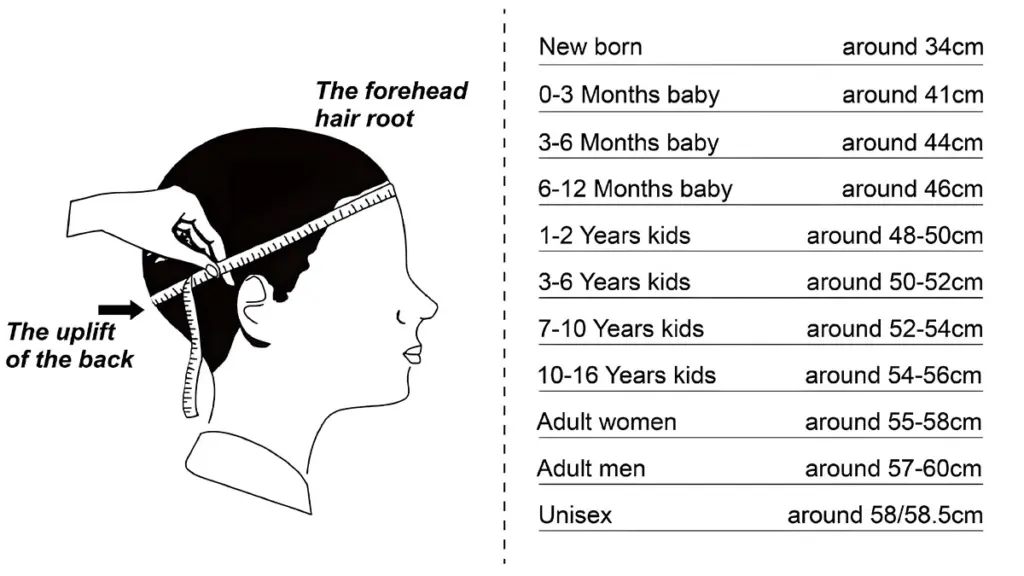
- Locate the forehead hairline. Place the zero end of the tape at the midpoint of the forehead, at the natural hairline (not the top of the forehead). For individuals with receding hairlines, use the supraorbital ridge (brow ridge) as the anterior reference point.
- Route the tape above the ears. Draw the tape horizontally around the head, keeping it level and passing just above the tops of the ears on both sides.
- Find the occipital prominence. At the rear, position the tape over the most prominent point of the back of the skull (the occipital protuberance). This is the widest point of the head when viewed from the side.
- Read the measurement. Pull the tape snug — firm contact with the skin, but not compressing the scalp. Read to the nearest 0.5 cm (or ¼ inch). Take three readings and use the largest value to ensure the hat will fit comfortably.
- Record in both units. Note the measurement in centimetres first, then convert: inches = cm ÷ 2.54.
Pro tip for B2B buyers: When collecting measurements from end-users (resort staff, lifeguard teams), provide a printed measurement card with this protocol and a paper tape measure. Self-reported hat sizes are unreliable — measured circumferences are not.
Master Head Circumference Size Chart: Newborn to Adult
The table below is the primary sizing reference for all straw hat orders. It is derived from our internal manufacturing standards, cross-referenced against WHO Child Growth Standards [¹] and CDC/NHANES anthropometric reference data [³].
Dual units are provided throughout. To convert cm to inches, divide by 2.54.
Complete Size Chart
| Age Group | Head Circumference (cm) | Head Circumference (inches) | Hat Size (approx.) |
|---|---|---|---|
| Newborn | ~34 cm | ~13.4 in | Preemie/NB |
| 0–3 Months | ~41 cm | ~16.1 in | 0–3M |
| 3–6 Months | ~44 cm | ~17.3 in | 3–6M |
| 6–12 Months | ~46 cm | ~18.1 in | 6–12M |
| 1–2 Years | 48–50 cm | 18.9–19.7 in | Toddler S/M |
| 3–6 Years | 50–52 cm | 19.7–20.5 in | Kids S/M |
| 7–10 Years | 52–54 cm | 20.5–21.3 in | Kids M/L |
| 10–16 Years | 54–56 cm | 21.3–22.0 in | Youth L/XL |
| Adult Women | 55–58 cm | 21.7–22.8 in | S–L |
| Adult Men | 57–60 cm | 22.4–23.6 in | M–XL |
| Unisex Adult | 58–58.5 cm | 22.8–23.0 in | One-Size |
Sources: Internal manufacturing standards cross-referenced with WHO Child Growth Standards (birth–5 years) [¹], CDC/NHANES anthropometric data [³], and published adult anthropometric literature.
Data Discrepancy Notes (Internal Chart vs. WHO/CDC)
| Age Group | Internal Chart | WHO Median (50th percentile) | Assessment |
|---|---|---|---|
| Newborn | ~34 cm | 34.5 cm (boys) / 33.9 cm (girls) | ✅ Within range |
| 0–3 Months | ~41 cm | ~40.5 cm (boys) / ~39.5 cm (girls) | ⚠️ Slightly high for girls; acceptable for boys |
| 3–6 Months | ~44 cm | ~43.3 cm (boys) / ~42.2 cm (girls) | ⚠️ Slightly high; hat will fit loosely on smaller infants |
| 6–12 Months | ~46 cm | ~46.1 cm (boys) / ~44.9 cm (girls) | ✅ Good fit for boys; slightly large for girls |
| Adult Men | 57–60 cm | Mean ~56.7 cm (literature) | ⚠️ Upper end (60 cm) is generous; covers large heads |
| Adult Women | 55–58 cm | Mean ~54.6 cm (literature) | ⚠️ Range starts slightly above mean; most women fit comfortably |
Practical implication: The internal chart skews slightly toward the larger end of each range. This is a deliberate manufacturing choice — a hat that is marginally large can be adjusted with inner band padding; a hat that is too small cannot be worn at all. For infant and toddler orders, buyers should confirm whether the end-user population skews toward the 50th or 75th+ percentile before finalising size ratios.
B2B Sizing Strategy: How to Structure Your Bulk Order
Understanding average head circumference is only half the equation. The other half is knowing how to distribute sizes across a bulk order to minimise leftover stock and fit complaints.
Regional Size Distribution
Head circumference averages vary meaningfully by geography. The following ratios are based on published anthropometric surveys and our manufacturing experience across markets:
| Region | Typical Adult Range | Recommended Bulk Ratio (S : M : L : XL) |
|---|---|---|
| North America / Australia | 57–61 cm | 10% : 30% : 40% : 20% |
| Western Europe | 56–60 cm | 15% : 35% : 35% : 15% |
| Latin America | 55–59 cm | 20% : 40% : 30% : 10% |
| East / Southeast Asia | 54–58 cm | 25% : 45% : 25% : 5% |
| Mixed / Global Resort | 55–60 cm | 15% : 35% : 35% : 15% |
Note: These ratios are starting-point guidelines, not guarantees. For institutional buyers (lifeguard associations, resort chains), always collect actual measured data from your end-user population before placing a large order.
Kids vs. Adult Split
For mixed-audience orders (beach clubs, family resorts, water parks), a typical split is 70% adult / 30% kids. Within the kids allocation:
- Ages 1–6 (toddler/small kids): ~40% of kids quantity
- Ages 7–16 (older kids/youth): ~60% of kids quantity
For kids lifeguard straw hat sizing, note that children’s head circumference grows rapidly in the first two years of life and then slows. A hat sized for a 3-year-old will not fit a 6-year-old. Always specify age range, not just “kids,” when placing an order.
One-Size-Fits-Most: Caveats
A “one-size” or “one-size-fits-most” straw hat typically targets the 58–58.5 cm range — the statistical midpoint of the adult unisex population. This works well for:
- Promotional giveaways where fit precision is secondary to coverage
- Festival and event hats with a short wear duration
- Adjustable-band designs that can accommodate ±2 cm variation
It does not work well for:
- Uniform programmes where consistent professional appearance is required
- Long-duration wear (lifeguard shifts, resort staff full-day use)
- Populations with a wide size distribution (mixed adult + youth)
For uniform and institutional applications, always specify at minimum two sizes (M and L) and ideally three (S, M, L).
Common B2B Sizing Mistakes — and How to Avoid Them
Even experienced procurement teams make these errors. Recognising them early saves significant cost.
Mistake 1: Relying on self-reported hat sizes
End-users routinely underestimate their head circumference. Always request measured values, not recalled hat sizes from previous purchases.
Mistake 2: Using a single size for a geographically diverse workforce
A resort with staff from multiple countries cannot assume a single size fits all. Collect measurements or use a regional distribution table.
Mistake 3: Ordering kids hats by age label alone
Children’s head circumference varies significantly within any age bracket. A 4-year-old can have a head circumference anywhere from 49 to 53 cm. Specify circumference ranges, not just age groups.
Mistake 4: Ignoring inner band allowance
A hat’s nominal size (e.g., 58 cm) refers to the inner circumference of the hat band, not the head circumference it fits. Most manufacturers add 0.5–1 cm of ease. Confirm the ease allowance with your supplier before approving samples.
Mistake 5: Not requesting a pre-production size sample
For orders above 200 units, always request a physical sample in each size before bulk production begins. Measure the inner band circumference yourself with a soft tape. This single step catches the majority of sizing errors before they become expensive.
How to Communicate Sizing Requirements to Your OEM Straw Hat Manufacturer
Clear, written sizing specifications are the difference between a smooth production run and a costly remake. When briefing your manufacturer through the OEM straw hat manufacturing process, include the following in your technical specification document:
Sizing Specification Checklist
- Head circumference range per size (in cm, e.g., Size M = fits 57–59 cm head circumference)
- Inner band circumference (the actual measurement of the hat’s interior, including ease allowance)
- Ease allowance (typically +0.5 to +1.0 cm; confirm with your factory)
- Size label format (numeric cm, S/M/L/XL, or age-based for kids)
- Size breakdown by quantity (e.g., 100 × S, 200 × M, 150 × L, 50 × XL)
- Inner band material and adjustability (fixed sewn band vs. adjustable drawstring vs. foam insert)
- Reference sample (if you have an existing hat that fits correctly, send it as a physical reference)
For wholesale custom panama hats and other structured styles, also specify the crown height and brim width, as these affect the perceived fit even when the head circumference is correct.
Once your specification is finalised, review the full ordering process to understand how sizing data flows from your brief through sampling, approval, and bulk production.
Frequently Asked Questions
What is the average adult head circumference for hat sizing purposes?
Based on published anthropometric data, the mean head circumference is approximately 56.7 cm (22.3 in) for adult men and approximately 54.6 cm (21.5 in) for adult women [adult anthropometric literature; see Sources]. For hat manufacturing, the practical adult range is 54–60 cm (21.3–23.6 in), with the majority of adults falling between 56–59 cm (22.0–23.2 in).
How do WHO child growth standards relate to hat sizing?
The WHO Child Growth Standards [¹] provide median head circumference values for children from birth to 5 years, by sex and age in months. These are the most authoritative reference for infant and toddler hat sizing. The CDC adopts and recommends these WHO standards for children under 2 years [³]. For children aged 2–16, published NHANES data and paediatric growth charts provide the reference range.
Should I order different sizes for male and female staff uniforms?
Yes, if your workforce is predominantly one sex. Men’s heads average approximately 2 cm larger than women’s. For a mixed-gender uniform programme, use a size range that covers both populations (typically S through L), or specify separate size runs if your brand requires a tailored fit.
How much size variation should I expect within a single age group for kids’ hats?
Significant variation. Within the 3–6 year age group, for example, head circumference can range from approximately 49 cm to 53 cm (19.3–20.9 in) across the 5th to 95th percentile [¹]. For institutional children’s programmes, measure a representative sample of the actual children rather than relying solely on age-based estimates.
What is the ISO standard for garment size designation, and does it apply to hats?
ISO 8559-1:2017 [²] defines anthropometric body measurement methodology for size designation of clothing. While it is primarily applied to garments, its measurement principles — including the use of a soft tape, defined anatomical landmarks, and standardised measurement posture — are directly applicable to hat sizing. Manufacturers following ISO 8559-1 methodology will produce consistent, reproducible size specifications.
Sources
- World Health Organization. Head circumference for age: Birth to 5 years. WHO Child Growth Standards. https://www.who.int/tools/child-growth-standards/standards/head-circumference-for-age
- International Organization for Standardization. ISO 8559-1:2017 — Size designation of clothes — Part 1: Anthropometric definitions for body measurement. https://www.iso.org/standard/61686.html
- Centers for Disease Control and Prevention. WHO Growth Charts — United States. https://www.cdc.gov/growthcharts/who_charts.htm
- Fryar CD, Gu Q, Afful J, Carroll MD, Ogden CL. Anthropometric Reference Data for Children and Adults: United States, August 2021–August 2023. Vital Health Stat 3(50). 2025. https://www.ncbi.nlm.nih.gov/books/NBK620761/
- Bushby KM, Cole T, Matthews JN, Goodship JA. Centiles for adult head circumference. Arch Dis Child. 1992;67(10):1286–1287. https://pmc.ncbi.nlm.nih.gov/articles/PMC1793909/