Lifeguard Association Bulk Hat Orders: How to Specify, Source, and Procure Custom UPF50+ Straw Lifeguard Hats from an OEM Manufacturer
How lifeguard associations & uniform suppliers spec, procure & order custom UPF50+ straw lifeguard hats in bulk from a Chinese OEM manufacturer. OSHA & AS/NZS compliant.
Byadmin
Table of Contents
The Procurement Decision You May Be Under-Classifying
Most equipment officers treat the annual hat order as a uniform line item — something to tick off between the whistle restock and the rescue tube replacement cycle. That framing is costing agencies compliance exposure they may not have budgeted for.
A wide-brim straw lifeguard hat worn during a full patrol shift is personal protective equipment. OSHA’s regulatory framework says so explicitly. The testing standards that define “UPF50+” — AS/NZS 4399:2020 in Australia and New Zealand, EN 13758 in Europe, AATCC TM183 in the United States — treat sun-protective headwear as a measurable, certifiable product category, not a fashion accessory. When your agency issues 200 hats to seasonal staff and junior program participants, you are making a PPE procurement decision with liability, compliance, and duty-of-care implications attached.
This guide is written for procurement managers, equipment officers, and uniform suppliers who need to move from “we need hats” to a fully specified, defensible bulk order — sourced from an OEM manufacturer capable of meeting the regulatory floor across multiple jurisdictions.
Why Bulk Is the Default Operating Mode for Lifeguard Associations
Lifeguard associations do not buy hats one at a time. The operational structure of a beach patrol agency makes bulk procurement the only rational approach.
Seasonal hiring cycles drive the largest single demand spike. Most Northern Hemisphere agencies onboard the majority of their seasonal workforce in a four-to-six-week window before Memorial Day or the equivalent regional season opener. Every new hire needs a complete kit on day one. There is no time for individual orders.
Junior lifeguard programs add a second, often larger, demand layer. Programs affiliated with USLA-certified agencies or SLSA/SLSNZ clubs can run cohorts of 30 to 300+ participants per season, many of them children requiring youth sizing. According to USLA’s own program data, junior lifeguard participation has grown consistently over the past decade, and those participants need properly fitted, properly rated sun protection — not adult hats cinched with a drawstring.
Replacement cycles create ongoing mid-season demand. Hats lost to wind, surf, and the general entropy of outdoor operations need to be replaced without triggering a new procurement event. Agencies that maintain a buffer stock of 10–15% above roster size avoid the operational disruption of emergency reorders.
Multi-beach chapters multiply all of the above. A single USLA-certified agency may operate across four, six, or ten beach locations under one administrative umbrella. Standardized equipment — including hats with consistent chapter branding — is both a professional presentation requirement and a public identification necessity. Bystanders need to identify your lifeguards instantly.
The United States alone has approximately 110 USLA-certified open-water lifeguard agencies, as noted on the USLA Executive Director’s page. Each of those agencies, plus the hundreds of municipal beach patrols, RLSS chapters, and SLSNZ-affiliated clubs operating globally, runs some version of this procurement cycle every year.
The Regulatory Floor: What Every Bulk Order Must Meet
Before you write a single line of your RFP, you need to understand what the regulatory environment actually requires. The answer is more specific than most procurement officers realize.
OSHA: 29 CFR 1910.132(a)
OSHA’s general industry PPE standard requires employers to assess workplace hazards and provide appropriate protective equipment at no cost to employees. Solar ultraviolet radiation is a recognized occupational hazard. OSHA’s 2000 interpretation of 29 CFR 1910.132(a) confirms that wide-brim hats constitute required PPE for outdoor workers in sun-exposed environments — a category that explicitly includes lifeguards and parks and recreation staff. An earlier 1998 OSHA standard interpretation reinforced the same position, identifying wide-brim hats as appropriate PPE for workers with prolonged outdoor sun exposure.
The practical implication: if your agency employs lifeguards as W-2 workers (rather than volunteers), issuing a hat that does not meet a defensible UPF standard is a potential OSHA compliance gap. “We bought hats” is not the same as “we provided compliant PPE.”
USLA Equipment Standards
According to USLA equipment standards, agencies are required to provide “reasonable equipment to protect lifeguards from sun exposure.” The standard does not specify a UPF rating by number, but the intent is unambiguous: sun-protective headwear is agency-issued equipment, not a personal responsibility item. Agencies seeking USLA certification or renewal should treat hat specification as part of their equipment compliance documentation.
CDC/NIOSH Guidance
The CDC’s NIOSH outdoor workers program recommends wide-brimmed hats as a primary engineering and administrative control for UV exposure, specifically noting that UV radiation peaks between 10 a.m. and 4 p.m. — which maps almost exactly to standard lifeguard duty hours. A 2022 PubMed study on lifeguard UV dose (de Troya Martín et al.) found that lifeguards receive UV doses significantly exceeding recommended daily limits during normal patrol shifts, reinforcing the case for maximum-rated sun protection rather than minimum compliance.
The WHO/ILO joint estimates on occupational UV exposure indicate that approximately one in four workers globally is exposed to solar UV radiation as part of their job — and outdoor aquatic workers are among the highest-exposure categories.
The Three Regional UPF Testing Standards
Any OEM manufacturer supplying a global customer base must be able to support testing and certification under three distinct standards:
- AS/NZS 4399:2020 — The Australian/New Zealand standard, administered and referenced by ARPANSA. This is the benchmark standard for SLSA and SLSNZ-affiliated procurement and is widely regarded as the most rigorous UPF testing methodology globally. UPF50+ under this standard means the fabric blocks ≥98% of UV radiation.
- EN 13758-1 and EN 13758-2 — The European standard covering both fabric testing (Part 1) and garment/hat classification (Part 2). Required for any supply into EU member states or RLSS UK chapters.
- AATCC TM183 — The American Association of Textile Chemists and Colorists test method used as the US domestic reference for UPF claims. Relevant for USLA-affiliated agencies and US municipal procurement.
When issuing an RFP to an OEM supplier, specify which standard(s) apply to your jurisdiction and request test reports — not just a UPF50+ label claim.
The Specification Sheet: What to Write Into Your RFP
A defensible bulk hat RFP for a lifeguard association should include the following technical specifications. Copy this list directly into your tender document.
Sun Protection
- UPF50+ rating, tested and certified per AS/NZS 4399:2020 (specify EN 13758-1/-2 for EU buyers; AATCC TM183 for US buyers)
- Test report from accredited third-party laboratory required with sample submission
Brim Geometry
- Minimum brim width: 8 cm all-round (10–12 cm preferred for full-shift patrol duty)
- Non-reflective brim underside (dark lining preferred — reduces glare bounce into wearer’s eyes)
- Brim must maintain shape under sustained wind and water exposure
Retention System
- Adjustable chin retention cord with toggle or breakaway safety release
- Anti-corrosive bronze or brass eyelets at chin strap anchor points
- Eyelets also required at crown ventilation points (minimum 4)
Shell Material
- Tightly woven natural straw: mat grass, cattail, hollow straw, or seagrass — specify preference or request material samples
- Weave density sufficient to achieve UPF50+ without additional UV-blocking treatment
- Colorfastness to UV and saltwater exposure (specify wash/exposure cycles)
Interior Finish
- Moisture-wicking sweatband (cotton or synthetic — specify)
- Content label and care label per regional regulatory requirements
- Size label (adult S/M/L; youth sizing if applicable)
Customization
- Chapter name / “LIFEGUARD” wordmark embroidery on crown or front panel
- Association logo: embroidered patch, woven label, or under-brim sublimation (specify method)
- Pantone color matching for thread and trim
Compliance Documentation
- UPF test report
- Material safety data (if applicable)
- Country of origin documentation for customs
Sizing Strategy for Bulk Orders Across a Roster
Sizing is where bulk orders most commonly go wrong. A hat that does not fit is a hat that does not get worn — which defeats the entire PPE rationale.
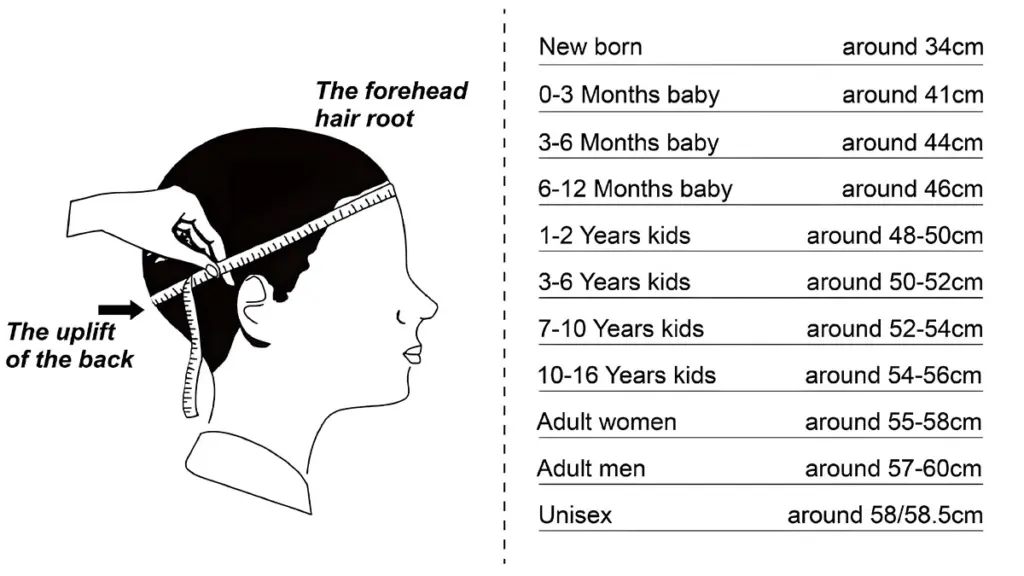
Adult standard sizing runs approximately 41 cm (length) × 43 cm (width) × 15 cm (crown height) for a medium/large fit. For a typical adult roster, a reasonable starting split is 20% Small, 50% Medium, 30% Large — adjust based on your historical fit data or a pre-season head circumference survey.
Youth sizing for junior lifeguard programs runs approximately 36 cm × 34 cm × 15 cm. If your junior program runs 8–16 year olds, you will likely need two youth size breaks. A kids’ lifeguard straw hat for junior programs should be specified as a separate line item in your PO, not assumed to be covered by adult sizing with a drawstring adjustment.
Practical recommendation: For a 200-unit adult order, request 10 units each of your two most common sizes as pre-production samples before committing to the full size split. Fit testing on actual staff before mass production approval is standard practice in institutional uniform procurement and should be standard here.
Branding and Customization at Volume
Chapter identification is not optional for a professional beach patrol. The public needs to identify your lifeguards at distance; your lifeguards need to identify each other across a crowded beach. Standardized, branded headwear is a functional operational requirement, not a marketing exercise.
At volume, you have four primary customization methods:
Crown embroidery is the most durable option for text and simple logos. “LIFEGUARD” wordmarks, chapter names, and badge-style crests hold well on tightly woven straw with a backing stabilizer. Minimum recommended thread count for legibility at distance: 5,000 stitches for a standard chest-width logo.
Woven patch offers higher design complexity than direct embroidery and can be produced separately and applied, allowing the same base hat to carry different chapter patches for multi-location agencies.
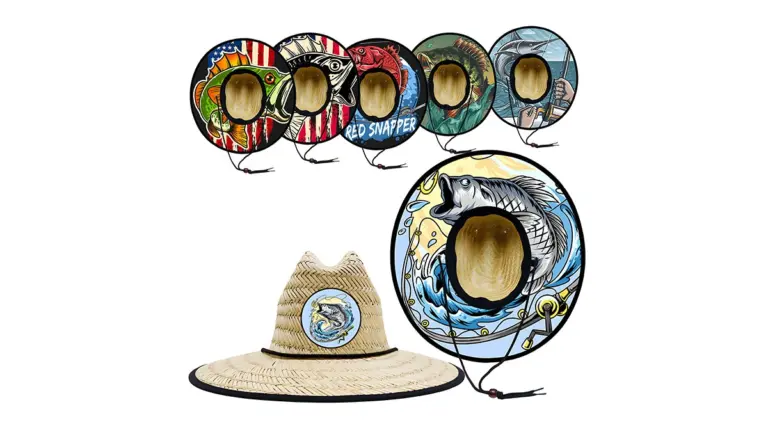
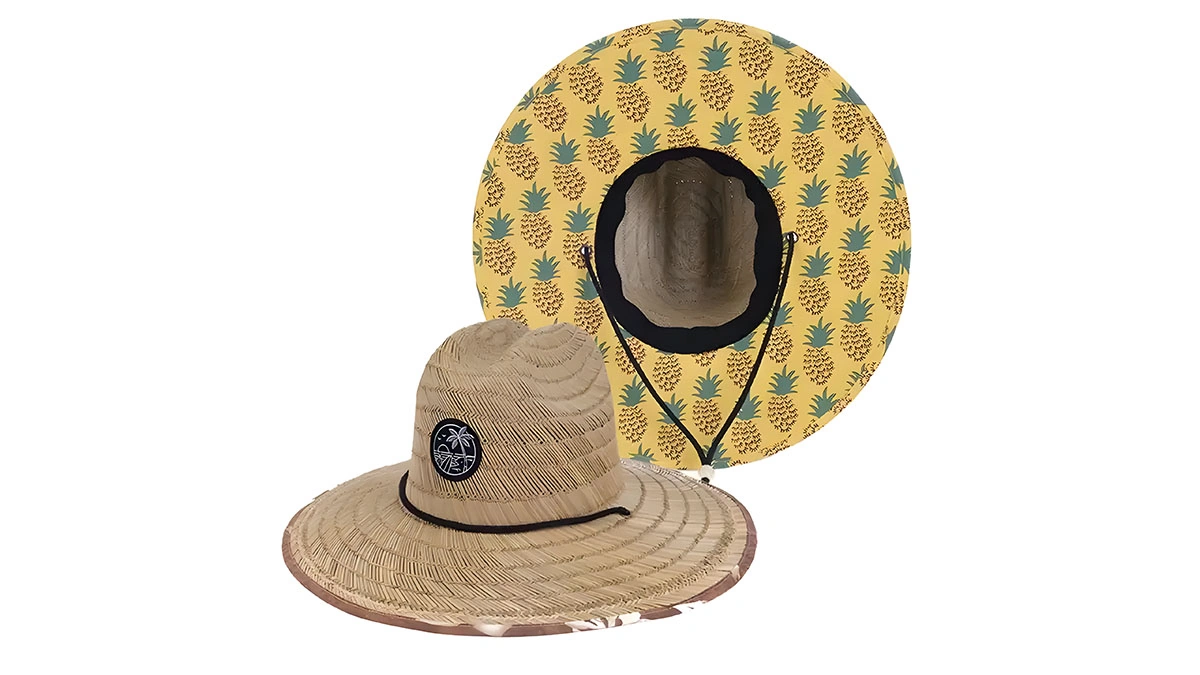
Under-brim digital sublimation allows full-color chapter colors, gradients, and photographic-quality graphics on the brim underside — visible to the wearer and to anyone looking up at the hat. This is increasingly used for junior program hats where visual engagement matters. See under-brim sublimation printing for method details.
Woven label inside the sweatband is standard for institutional identification and laundry tracking — include your agency name, issue year, and size.
The logo embroidery and patch service supports all of the above methods. Submit vector artwork (AI or EPS) with Pantone color references for accurate color matching.
Grass material options affect both aesthetics and performance. The four primary options — mat grass, cattail, hollow straw, and seagrass — differ in weave density, flexibility, and UV-blocking baseline. Request material swatches with your initial sample order and evaluate against your UPF test requirement before committing.
MOQ, Lead Time, and Season-Start Planning
Understanding the production and logistics timeline is the single most important factor in avoiding the emergency reorder scenario that costs agencies both money and operational disruption.
Minimum Order Quantities
- Standard MOQ: 50 pieces per style
- Custom embroidery and chapter colors: available from 50 units
- Mixed designs within a single PO: 10–30 units per design variant (confirm with supplier at RFP stage)
Sample Timeline
- Catalog samples: free; buyer pays outbound shipping
- Sample lead time: 7 days from request confirmation
- Pre-production (PP) sample: 3 days after design approval
Production Timeline
- Mass production commencement: after PP sample written approval
- Production duration: 5–15 days for standard orders; 20–30 days for full mass production runs (500+ units with complex customization)
Freight Timeline
- Sea freight (China to US West Coast): 25–35 days transit
- Sea freight (China to Australia/NZ): 18–28 days transit
- Air freight: 5–7 days (available for emergency restock; significant cost premium)
- Customs clearance: add 3–7 days buffer for US Customs; 5–10 days for AU/NZ biosecurity inspection of natural fiber products
The 90-Day Rule
If your season starts June 1, your hats need to be in your warehouse by May 15 at the latest. Working backward: customs clearance by May 8 → vessel arrival by May 1 → vessel departure by April 1 → production complete by March 15 → PP sample approved by March 1 → sample ordered by February 15 → RFP issued and supplier confirmed by February 1.
Plan procurement 90+ days before season start. For agencies with March season openers (Southern Hemisphere summer programs, Florida year-round operations), that means November procurement initiation. This is not a conservative estimate — it is the minimum viable timeline for a compliant, custom-branded bulk order via sea freight.
Bulk Procurement Workflow: From RFP to Delivery
The following seven-step workflow maps the full procurement cycle for a lifeguard association bulk hat order. Use this as a checklist for your internal procurement documentation.
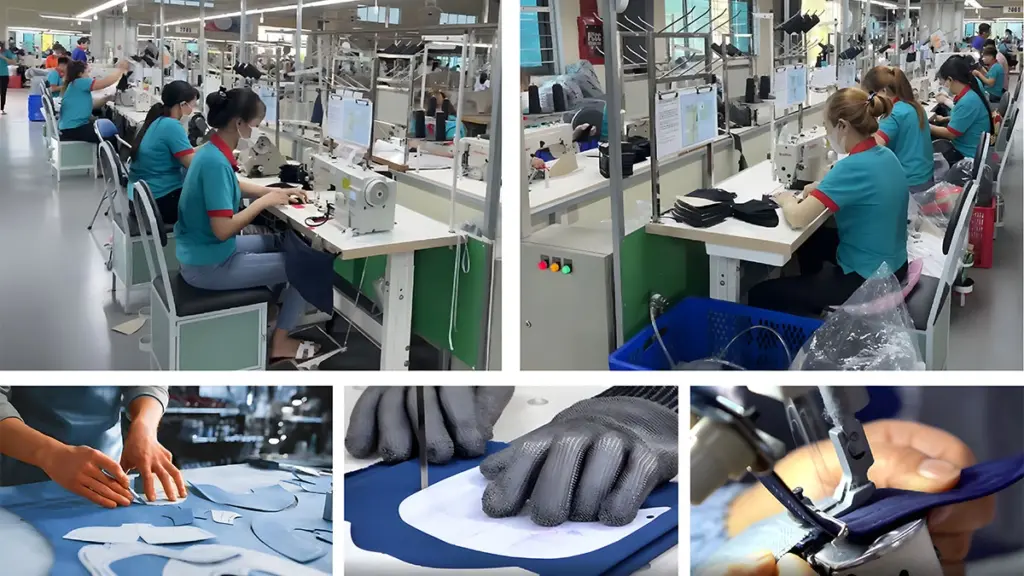
Step 1 — Issue RFP with Full Specification Sheet
Distribute your technical spec (as detailed in Section 4 above) to qualified OEM suppliers. Include required certifications, customization requirements, size split, delivery destination, and required delivery date. Request unit pricing at your target volume, sample availability, and production capacity confirmation.
Step 2 — Sample Request
Request catalog samples of the base hat style(s) under consideration. Samples are typically provided free of charge; buyer pays outbound shipping. Evaluate against your spec: brim width, weave density, retention system, interior finish. Request UPF test reports for any sample that passes visual inspection.
Step 3 — Pre-Production (PP) Sample Approval
After supplier selection, submit your artwork files and size specifications. The supplier produces a PP sample incorporating your embroidery, patch, or sublimation artwork on the confirmed base hat. Review against spec and provide written approval or revision instructions. Do not proceed to mass production without written PP sample sign-off.
Step 4 — Mass Production with In-Line QC
Production commences after PP approval. A reputable OEM supplier conducts in-line quality control checks at key production stages — weave inspection, embroidery registration, sweatband attachment, eyelet installation. Request in-line QC reports as a contractual deliverable.
Step 5 — Pre-Shipment Inspection Report
Before goods are loaded, request a pre-shipment inspection (PSI) report covering: unit count verification, random sample measurement against spec, embroidery/artwork accuracy, packaging integrity. Third-party inspection (SGS, Bureau Veritas, Intertek) is available for high-value orders and is standard practice in institutional procurement. Review the quality control and inspection process for what a compliant PSI covers.
Step 6 — Sea/Air Freight and Customs
Confirm Incoterms with your supplier (FOB, CIF, or DDP — each allocates freight and customs responsibility differently). Ensure your customs broker has the commercial invoice, packing list, certificate of origin, and any required phytosanitary certificates for natural fiber products entering AU/NZ.
Step 7 — Receipt and Quality Window
Upon delivery, conduct a receiving inspection against the PSI report. Document any discrepancies immediately. A standard quality window of 7 days from receipt is typical for institutional orders — confirm this in your purchase agreement. Retain one unit per size per design as a reference sample for future reorder matching.
Real Example: How Municipal Procurement Treats Lifeguard Hats
The City of Austin’s lifeguard gear procurement contract (Contract 142588, documented in public procurement records) line-items “Hat” as a discrete equipment category alongside shirt, whistle, and rescue tube in the lifeguard gear specification. This is not incidental. Municipal procurement frameworks that have gone through formal competitive tender processes have already made the determination that headwear is a separately specified, separately sourced piece of lifeguard equipment — not a bundled uniform accessory.
For associations operating under public agency oversight or seeking USLA certification, this framing matters. Treating the hat as a PPE line item in your procurement documentation — with its own specification, its own compliance documentation, and its own supplier qualification — is consistent with how the most professionally managed agencies in the sector already operate.
Frequently Asked Questions
Does your lifeguard hat OEM service support UPF50+ certification for both AS/NZS 4399:2020 and EN 13758?
Yes. Our Custom Lifeguard Straw Hat — full OEM/ODM manufacturing service supports third-party UPF testing under AS/NZS 4399:2020 (for SLSA/SLSNZ and Australian municipal buyers), EN 13758-1/-2 (for EU and RLSS UK buyers), and AATCC TM183 (for US buyers). Test reports from accredited laboratories are available as a contractual deliverable. Specify your required standard(s) in your RFP and we will confirm testing coverage before sample submission.
What is the smallest order quantity that still qualifies for full custom embroidery and chapter colors?
Full custom embroidery, woven patch, and chapter color customization are available from 50 units per style. Mixed design variants within a single PO are available at 10–30 units per variant, subject to confirmation at the RFP stage. There is no minimum for sweatband label customization — agency name and issue year labeling is standard on all institutional orders regardless of volume.
We hire seasonal junior lifeguards in March — when do we need to place our order?
For a March season start, procurement should be initiated no later than early December of the prior year. The minimum viable timeline — RFP issuance through PP sample approval, mass production, sea freight transit, and customs clearance — runs 90+ days. For Southern Hemisphere agencies with November or December season openers, August procurement initiation is the equivalent benchmark. Air freight is available for emergency restock situations but carries a significant cost premium and should not be the primary logistics plan.
Can you produce both adult and youth sizes in the same PO with a single MOQ?
Yes. Adult and youth sizes can be combined within a single purchase order. The 50-unit MOQ applies to the total order, not per size. A PO combining, for example, 35 adult medium and 15 youth small units meets the MOQ threshold. Size splits should be confirmed at the PP sample stage to ensure fit verification across both size categories before mass production commitment.
Sources and References
- USLA Equipment Standards — https://www.usla.org/?page=EQUIPMENTSTANDARDS
- USLA Certified Agencies — https://www.usla.org/page/CERTIFIEDAGENCIES
- USLA Executive Director / Agency Count — https://www.usla.org/page/ExecutiveDirector
- OSHA Standard Interpretation 1998-04-16 (wide-brim hats as PPE for outdoor workers) — https://www.osha.gov/laws-regs/standardinterpretations/1998-04-16
- OSHA Standard Interpretation 2000-06-19 (parks & recreation; lifeguards) — https://www.osha.gov/laws-regs/standardinterpretations/2000-06-19
- OSHA Publication 3166 — Sun Exposure in the Workplace — https://www.ars.usda.gov/ARSUserFiles/50620000/HealthandSafety/OSHA_sunlight.pdf
- CDC/NIOSH — Outdoor Workers: Sun Exposure — https://www.cdc.gov/niosh/outdoor-workers/about/sun-exposure.html
- WHO/ILO Joint Estimates — Occupational UV Exposure — https://www.who.int/teams/environment-climate-change-and-health/monitoring/who-ilo-joint-estimates
- ARPANSA — AS/NZS 4399:2020 Sun Protective Clothing Standard — https://www.arpansa.gov.au/our-services/testing-and-calibration/ultraviolet-services/labelling-sun-protective-clothing/au-standard
- AATCC TM183 — Transmittance or Blocking of Erythemally Weighted UV Radiation Through Fabrics — https://members.aatcc.org/store/tm183/579/
- EN 13758-1:2001+A1:2006 — Solar UV Protective Textiles: Test Method for Apparel Fabrics — https://genorma.com/en/standards/en-13758-1-2001-a1-2006
- EN 13758-2:2003+A1:2006 — Solar UV Protective Textiles: Classification and Marking of Apparel — https://genorma.com/en/standards/en-13758-2-2003-a1-2006
- Surf Life Saving New Zealand — Patrol Operations Manual 2022 — https://www.surflifesaving.org.nz/media/996576/slamanual2022-final-sml.pdf
- de Troya Martín et al. (2022) — UV Dose in Lifeguards During Occupational Exposure — PubMed — https://pubmed.ncbi.nlm.nih.gov/34178403/
- City of Austin — Lifeguard Swimsuits and Lifeguard Gear Contract 142588 — https://www.highergov.com/sl/contract-opportunity/tx-lifeguard-swimsuits-and-lifeguard-gear-51347860/